
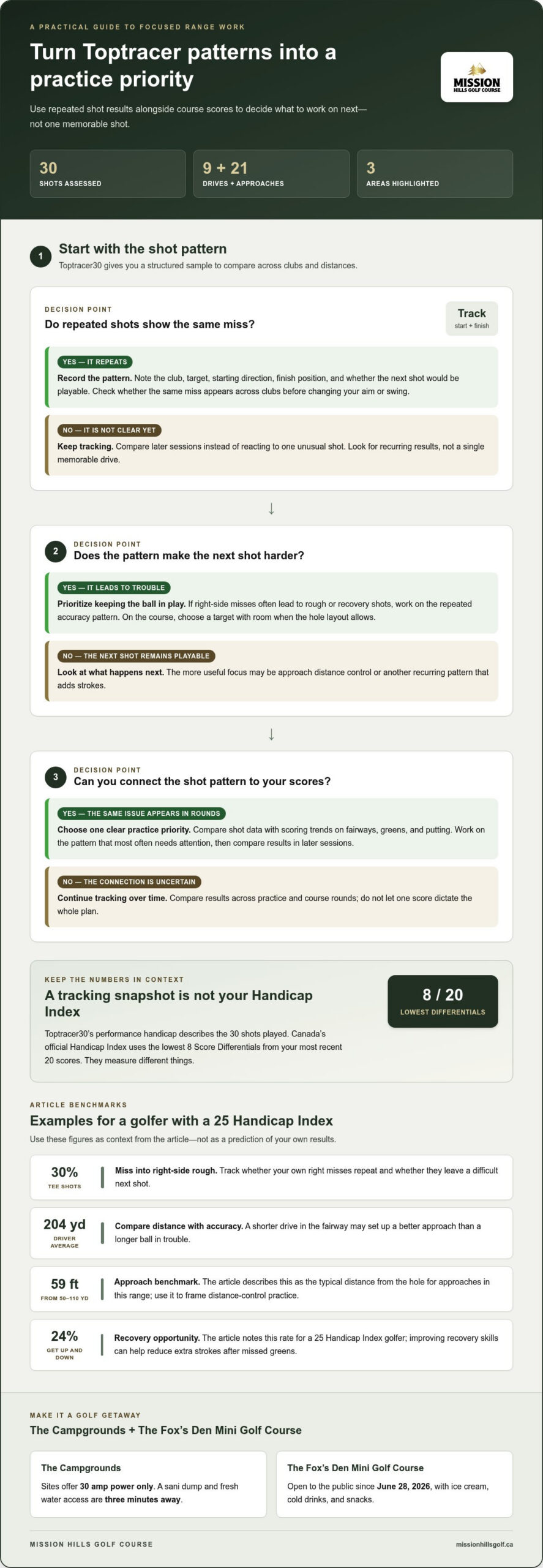
Using Toptracer to lower my handicap starts with turning shot data into focused practice, not treating a range result as an official Handicap Index. Toptracer30 assesses 30 shots and highlights three areas to improve, while Canada’s Handicap Index is based on the lowest 8 of your most recent 20 Score Differentials.
A single scorecard can’t always show why your scores are adding up. Shot tracking can reveal patterns, such as tee shots drifting off line or approach shots leaving long putts, so you can practise with a clearer purpose.
Learn how to read those patterns, connect them to scoring trends, and choose useful practice priorities. We’ll also explain what Toptracer’s performance handicap tells you and how it differs from your official Handicap Index.
Key Takeaways
- Toptracer30 can highlight three areas to work on, but its performance handicap is not your official Canadian Handicap Index.
- Look for repeated shot patterns, such as tee shots missing right, to choose a more focused practice goal.
- Track scoring trends alongside shot data to see where trouble with fairways, greens, or putting may be adding strokes.
- Make The Campgrounds part of your golf getaway: sites have 30 amp power only, with a sani dump and fresh water access three minutes away.
- Add amazing fun at The Fox’s Den Mini Golf Course, open to the public since June 28, 2026, with ice cream, cold drinks, and snacks.
Using performance tracking to identify areas for improvement
Shot tracking turns practice into useful evidence. Compare repeated results with your course scores to identify which shots are costing strokes.
Toptracer30 measures 30 shots and points to three areas for improvement. Watch this video for a look at the challenge in action:
Tracking performance patterns
Performance tracking records where shots finish and how consistently you reach targets. That pattern matters because one strong round can hide repeat trouble, such as approaches that regularly leave long putts. Toptracer30 includes nine drives and 21 approach shots, giving you a structured sample to compare across clubs and distances.
Use the results to choose one practice priority, then compare later sessions. For example, a golfer with a 25 handicap index typically finishes 59 feet from the hole on approaches from 50 to 110 yards. That benchmark can help frame a goal: improve distance control and leave shorter putts, rather than chasing a perfect shot.
Toptracer30 also gives a performance handicap for the 30 shots played. Treat it as a practice snapshot, not an official handicap index. The World Handicap System calculates a Canadian index from the lowest 8 Score Differentials among your most recent 20 scores. A session score and an official differential measure different things.
Handicap improvement methods
Handicap improvement comes from reducing costly mistakes and making more consistent scoring decisions. Track tee shots, approaches, and putting, then focus practice on the pattern that appears most often. A 25 handicap golfer gets up and down 24% of the time, so improving recovery skills can help turn missed greens into fewer extra strokes.
Protect your score by keeping more tee shots in play and choosing a safe target when trouble threatens. Aiming away from hazards may leave a longer approach, but avoiding a penalty or recovery shot can save strokes. On the course, make the next shot easier rather than forcing a risky line.
For using Top Tracer to lower my handicap, connect range patterns with rounds played on a course. Your course handicap changes with the tees and course difficulty. It uses your handicap index, the tee’s Slope Rating divided by 113, and the difference between Course Rating and par. Compare that context with your shot tracking to set practice goals that address both accuracy and scoring.
Use GPS, shot trackers, and scoring apps to understand performance trends beyond a single scorecard. Comparing results across these tools helps you focus on recurring patterns instead of letting one score dictate what to practise. Use the trends to set a priority, then keep tracking your performance over time. The goal is to connect your practice decisions to observable patterns, not to treat one round as the whole story.
For golfers in Canada, reducing big scores often means keeping more balls in play, improving wedge distance control, and limiting three-putts. Use these priorities to turn performance tracking into action: identify the area that most often needs attention and make it your focus. Keep the plan manageable by working on one clear pattern rather than trying to change everything at once. This helps direct practice towards the parts of your game that matter most to scoring.
Tee-shot accuracy and misses to the right
A right miss can turn a playable tee shot into rough, a blocked approach, or a recovery. For golfers with a 25 handicap index, 30% of tee shots miss into the right-side rough. Use shot tracking to see whether your own right misses repeat, then compare them with shots finishing in the fairway. That pattern gives you a clearer practice target than judging your accuracy from one memorable drive.
Start by recording where each drive finishes, not just how far it travels. Toptracer30 includes nine drives, giving you a sample to examine for direction and consistency. Note whether the ball starts right, curves right, or finishes right after a straight flight. Those outcomes suggest different practice questions. For example, if several drives finish right, check whether the same miss appears with different clubs before changing your aim or swing.
Distance matters, but only alongside accuracy. A golfer with a 25 handicap index averages 204 yards with a driver. Compare that average with your own results, while also asking whether your typical landing area leaves a clear next shot. A shorter drive in the fairway may create a better approach than a longer ball in rough or behind an obstacle. Track both the landing position and the next-shot situation.
Keep a simple practice record. For each session, note the club, target, starting direction, finish position, and whether the ball would leave a playable next shot. After several sessions, look for recurring misses instead of reacting to one unusual shot. If you miss right most often, choose a clear target line and assess each shot against it. Change one practice focus at a time, then compare your next results.
On the course, manage a right-side miss by choosing a target with room on the left, when the hole layout allows. This can keep the ball in play even if your usual shot shape stays the same. Avoid aiming directly at a hazard or narrow landing area just to chase extra distance. A controlled tee shot can reduce difficult recovery situations and leave you with a more comfortable next stroke.
Use your tracking notes to connect accuracy with actual scores. If drives finishing right often lead to recovery shots, prioritize keeping the ball in play. If those misses still leave an open approach, your next focus may be distance control instead. Compare practice patterns with rounds over time, and take your tee-shot work to Cranbrook golf practice when you’re ready to put the data to use.
Using tracking tools to identify scoring trends
Scores become more useful when you separate them by hole type and shot outcome. Track your total strokes on par 3s, par 4s, and par 5s, then compare those averages across rounds. A scorecard shows the total; a simple log can reveal whether one type of hole repeatedly adds pressure. Record penalties, missed greens, and three-putts beside each hole to see what contributed to the score.
For golfers with a 25 handicap index, the average is 4.19 strokes on par 3s, 5.87 on par 4s, and 6.98 on par 5s. Treat these figures as reference points, not targets for every round. If your par 5 scores stand out, check whether a penalty, a difficult recovery, or an extra putt often appears. That detail points toward a more useful practice focus than the hole total alone.
Putting can also shape a scoring pattern. Golfers with a 25 handicap index three-putt 13% of the time. Note the length of the first putt and how many putts finish the hole. If long first putts often lead to three-putts, distance control may deserve attention. If shorter putts are the issue, record those separately. These patterns help distinguish lag-putting practice from work on shorter finishes.
Compare your round notes with course details before drawing conclusions. Course rating, tee selection, and playing conditions all affect how you interpret a score. In Canada, a Score Differential is calculated using adjusted gross score, Course Rating, Slope Rating, and the Playing Conditions Calculation. This adds useful context when comparing scores from different courses or tees.
Keep your records clear and consistent. After each round, note total strokes, penalties, three-putts, and scores by hole type. Add a short note when a decision affected the result, such as taking a risky line instead of aiming away from trouble. When the same issue appears across multiple rounds, make it your next practice priority. A repeated scoring pattern matters more than one unusual hole.
Tracking tools can also show whether a change carries from practice into play. Compare the type of shot you worked on with the scorecard result, rather than relying on memory. For example, if par 4s remain your highest average, check whether the extra strokes come from tee shots, approaches, or putting. That breakdown gives you a specific question to address in your next practice session.
Fairways hit and greens in regulation
Fairways hit and greens in regulation measure different parts of a hole. A fairway result reflects tee-shot accuracy, while a green result shows whether your approach reaches the putting surface in regulation. Track both across rounds. A golfer with a 25 handicap index hits 50% of fairways in regulation, but averages only 9% greens in regulation. That gap shows why fairway accuracy alone may not explain scoring.
Record where each drive lands and the outcome of the next shot. A fairway hit can still leave a difficult approach, while a miss may offer a clear route to the green. Compare results by club and lie. For example, note whether a fairway miss leaves you blocked by trees or simply in light rough. These details help distinguish a tee-shot issue from an approach-shot challenge.
Approach results can reveal a specific club pattern. Golfers with a 25 handicap index average 5% green success with a 3 wood, 5 wood, 3 hybrid, or 4 hybrid. If your notes show similar difficulty, consider whether those clubs suit the distance and lie you face. Compare their outcomes with shorter clubs, and practise the shots that repeatedly leave you short or offline.
Use the same simple record for every round: fairway hit or miss, approach club, green hit or missed, and the result of the next shot. Add the miss direction, such as short, long, left, or right. These details make your numbers useful. If your fairway rate is steady but you still miss greens, focus on approach distance and direction rather than changing your driver practice.
Shot-tracking results can guide practice, but they don’t automatically change your Handicap Index. In Canada’s handicap system, acceptable round scores produce Score Differentials, and the index uses the lowest 8 of the most recent 20. For handicap purposes, once you have an index, a hole score is generally capped at net double bogey. Your practice stats show what to work on; posted scores determine the handicap calculation.
Review the pattern after each group of rounds, not after one frustrating hole. If approaches from a particular club repeatedly miss the green, practise that club and compare the next results. If misses vary, work on choosing a reliable target and making a controlled swing. Use focused golf practice to test those choices and build a clearer picture of your fairway and green results.
Adding distance off the tee can help 25 handicap golfers hit shorter clubs into greens. When reviewing your rounds, note whether a longer drive changes the club you use for the approach, then compare the green results with your usual pattern. This keeps distance connected to the next shot, rather than treating a longer drive as an end in itself.
If you’re practising for more distance, check whether it leaves you with a shorter approach and whether that club feels more comfortable. Look at the full sequence from tee to green: the useful result is the one that gives you a manageable approach and a clearer chance to reach the putting surface.
Personalized insights for practice
Personalized practice starts by matching a repeatable weakness with a specific skill to train. Toptracer30 offers a performance handicap for its assessment and identifies three areas that could improve. Use those results to choose a clear focus, rather than dividing every session equally across your game. A result is most useful when it points to a shot you can practise deliberately.
For example, golfers with a 25 handicap index make 35% of putts from 6 to 12 feet. If this range causes trouble in your rounds, practise controlling pace and starting direction from those distances. Track how often your ball finishes close enough for a short next putt. That measure gives you a concrete way to compare sessions without expecting every attempt to drop.
Short-game practice can also target a defined situation. A 25 handicapper hits the ball inside 6 feet from the fringe, from 20 yards away, approximately 23% of the time. Use this as context when reviewing your own results, not as a universal standard. Practise the same type of shot, then note landing distance and direction. Those details can show whether contact, carry distance, or aim needs attention.
Toptracer30 game scores use whole numbers from 0 to 1,000. The reference handicap entered when starting a game doesn’t affect the performance handicap or game score. That distinction matters: the game score reflects the assessment, while your World Handicap System index represents demonstrated ability through eligible course scores. Use each measure for its own purpose, and don’t treat one as a replacement for the other.
Build your practice plan around one priority at a time. If your assessment flags approach accuracy, work towards a consistent target and compare shot dispersion. If putting distance stands out, group attempts by starting distance and record where they finish. Keep your focus steady long enough to identify a pattern. Then review the results and decide whether to continue or move on to another area.
Course difficulty also shapes what your official handicap represents. Course Rating estimates the score a scratch golfer would make, while Slope Rating describes relative difficulty for players who are not scratch golfers. These ratings help calculate a Handicap Index adjustment for a specific course and tee. Apply your practice insights on the course, then use focused golf practice to keep working on the shots you’ve identified.
Mission Hills Golf Course: Campground Stay & Play
Mission Hills Golf Course makes it easy to pair focused golf with a relaxed stay at The Campgrounds. Campground Stay & Play puts golf and downtime together, with Birdies Kitchen & Bar adding an easy place to enjoy a meal. The campground offers 30 amp power only; a sani dump and fresh water access are three minutes away.
Make room for amazing fun at The Fox’s Den Mini Golf Course, open to the public since June 28, 2026. Enjoy ice cream, cold drinks, and snacks, too. It’s celebrated as “Canada’s Most Amazing” and “Best” Mini Golf Property, making it a lively addition to a Cranbrook golf getaway.
Contact Mission Hills Golf Course to plan your stay.
Turn your next practice session into a clear plan
Choose one pattern from your tracking, set a focused practice goal, then see how it carries into your next round. If you’re using Top Tracer to lower your handicap, treat each session as a chance to learn what deserves attention, not a test you need to ace. Small, deliberate adjustments give you useful feedback for your next practice session.
Make golf part of a wider Cranbrook getaway, too. The Campgrounds bring your stay and play together, with time to practise, enjoy a round, and unwind with other on-site activities. At Mission Hills Golf Course & Campground in Cranbrook, you can keep enjoying the game while giving your improvement plan room to grow.
Ready to plan your next visit? Contact Mission Hills Golf Course and make space for more golf, practice, and fun. Every session is another opportunity to learn and enjoy your game.
Frequently Asked Questions
What Is a Golf Handicap?
A golf Handicap Index is a measure of a player’s demonstrated ability, not their average score. In Canada, it helps compare players with different skill levels and adjust for course difficulty. The maximum Handicap Index is 54.0. For example, a player’s Index can help determine how many handicap strokes they receive on the tees they’re playing, making competition more balanced.
How can your handicap change?
Your Handicap Index can change as new acceptable scores enter your scoring record. In Canada, it uses the lowest 8 Score Differentials among your most recent 20 scores, so a new result can affect the calculation as older scores move out. The Index should update by the day after a score is submitted, or as soon as possible thereafter. A strong round may lower it; a higher differential can affect it differently.